
So you brought home a new puppy. Congratulations! You are probably staring at that cute little face thinking, “How am I going to keep my carpets clean?” I get it. Potty training is the very first thing every new puppy owner asks me about. And here is the good news: it is totally doable. I have helped hundreds of families potty train their puppies, and I am going to walk you through every single step.
Potty training is not magic. It is a system. When you follow the system, your puppy learns where to go and when to go. When you skip steps, accidents happen. So let me teach you the system I have used for over a decade.
What You Need Before You Start
Before we get into the step-by-step plan, let me tell you what supplies you need. Having these things ready makes everything easier.
- A crate that is just big enough for your puppy to stand up, turn around, and lie down. Not bigger. Puppies do not like to potty where they sleep.
- Puppy pads or a designated potty spot outside. Pick one method and stick with it.
- Enzyme cleaner. Regular cleaner does not remove the smell. If your puppy smells pee, they will pee there again.
- Treats. Small, soft treats your puppy loves. These are for rewarding good behavior.
- A leash. Even if you have a fenced yard, a leash keeps your puppy focused on potty time.
- Patience. This is the most important one. You will need it.
Step 1: Set Up a Schedule
Puppies thrive on routine. I tell all my clients the same thing: a predictable schedule is your best friend. When your puppy knows what to expect, they feel safe. And when they feel safe, they learn faster.
Here is the schedule I recommend for puppies under 6 months old. Take your puppy out at these times:
- First thing in the morning when they wake up
- After every meal (within 5 to 10 minutes)
- After a nap
- After playtime
- Before bedtime
- Once during the night if your puppy is under 12 weeks old
- Every 2 to 3 hours during the day
I know this sounds like a lot. It is a lot. But think of it this way: every time you take your puppy out at the right time, you prevent an accident. And every accident you prevent teaches your puppy that outside is the right place.
Step 2: Pick a Potty Spot
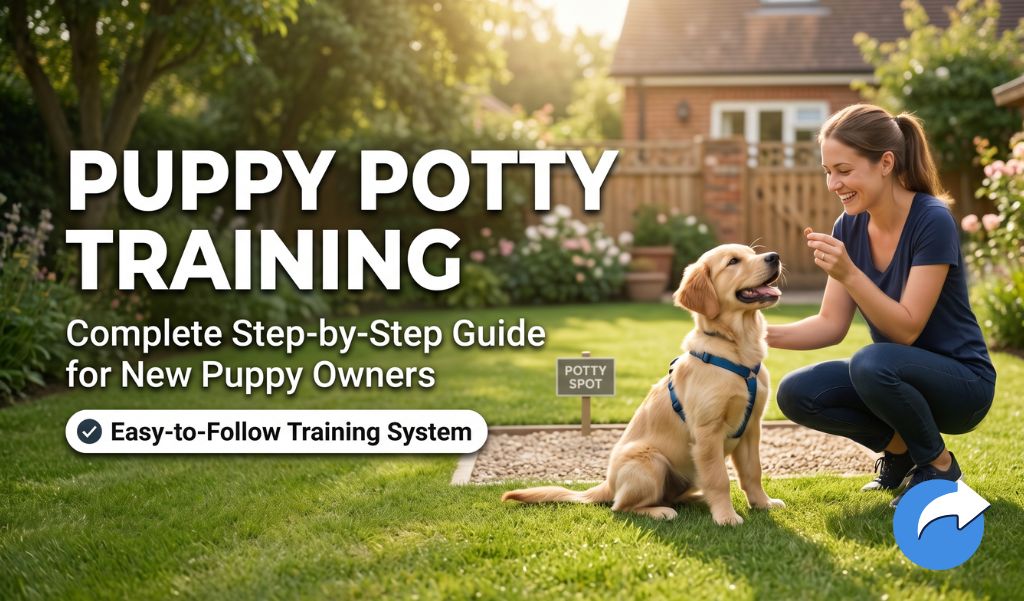
Choose one spot outside where you want your puppy to go. Take them to the same spot every single time. I cannot stress this enough. The smell of that spot tells your puppy, “This is the bathroom.”
When you take your puppy to the spot, keep them on a leash. Stand still. Do not play. Do not talk much. Just say your potty cue word. I use “Go potty.” You can use whatever words you like. Just be consistent.
Give your puppy 3 to 5 minutes. If they go, give them a treat and lots of praise. If they do not go, take them back inside and put them in their crate. Try again in 15 minutes. This teaches your puppy that potty time is for potty, not for playing.
Step 3: Watch for the Signs
Every puppy gives signals before they potty. You just need to learn what they look like. I tell my clients to watch for these signs:
- Sniffing the floor in circles
- Walking in a circle and squatting
- Whining or barking for no reason
- Suddenly leaving the room
- Scratching at the door
- Getting restless during play
The moment you see any of these signs, grab your puppy and take them outside. Do not wait. Do not finish what you are doing. Every second counts. If you wait too long, you will have an accident.
Step 4: Use the Crate
The crate is a potty training tool, not a punishment. Puppies naturally do not want to potty where they sleep. This instinct is your biggest advantage. When you cannot watch your puppy, put them in the crate.
Here are my crate rules for potty training:
- The crate should be the right size. If it is too big, your puppy will potty in one corner and sleep in the other.
- Never leave a puppy in the crate for more than 2-3 hours during the day. They cannot hold it longer than that.
- Take your puppy straight to the potty spot when you let them out of the crate.
- Do not use the crate as punishment. Your puppy should love their crate.
Step 5: Handle Accidents the Right Way
Accidents will happen. I promise you, every single puppy owner deals with accidents. The key is how you handle them. If you find an accident, here is what to do.
First, do not punish your puppy. If you found the accident after it happened, your puppy will not connect your anger with the potty. They will just learn that you are scary sometimes. That does not help anything.
Second, clean the spot with enzyme cleaner. Regular cleaner leaves behind scent markers that attract your puppy back to the same spot. Enzyme cleaner breaks down those markers completely.
Third, think about why the accident happened. Did you wait too long between potty breaks? Did you miss the signs? Adjust your schedule and do better next time. Accidents are feedback. They tell you where your system needs improvement.
Step 6: Reward Success Every Time
Positive reinforcement is the fastest way to train a puppy. When your puppy potties outside, make a big deal about it. Give them a treat. Give them praise. Use a happy voice. Let them know they did exactly what you wanted.
I keep a small container of treats by the door where we go out. That way I never forget to reward my puppy. The reward needs to happen right away, not when you get back inside. If you wait, your puppy will not connect the reward with the potty.
As your puppy gets better, you can start giving treats sometimes instead of every time. But in the beginning, reward every single success. This builds a strong habit.
Common Potty Training Mistakes to Avoid
I see the same mistakes over and over again. Let me save you the trouble by telling you what to avoid.
- Free feeding. If you leave food out all day, your puppy will potty all day. Feed meals at set times. This makes potty breaks predictable.
- Giving too much freedom. A puppy who has the run of the house will have accidents everywhere. Keep your puppy confined to a small area unless you are watching them.
- Waiting too long between breaks. A 2-month-old puppy can hold their bladder for about 2 hours. That is it. Do not expect more.
- Using pee pads and outside. Pick one method. Using both confuses your puppy. If you want them to go outside, skip the pee pads.
- Rubbing their nose in it. This is an old myth. It does not work. It just scares your puppy and damages your bond.
Nighttime Potty Training
Nighttime is the hardest part for most new puppy owners. You are tired. You want to sleep. But your puppy’s bladder is tiny. Here is how to handle it.
Set an alarm for the middle of the night. For puppies under 12 weeks, set one alarm about 3 to 4 hours after bedtime. Take your puppy out on a leash. No play. No talking. Just potty. Then right back to the crate.
As your puppy gets older, they will be able to hold it longer. At 4 months, most puppies can sleep through the night. But every puppy is different. Some take longer. Do not rush it.
One more tip: stop feeding your puppy 2 to 3 hours before bedtime. And take away their water bowl 1 hour before bed. This gives their bladder time to empty before sleep.
How Long Does Potty Training Take?
This is the question I get asked most often. The honest answer is that most puppies are reliably potty trained somewhere between 4 and 6 months old. But some puppies take longer. Small breeds often take longer because they have smaller bladders. Large breeds usually catch on faster.
The timeline depends on how consistent you are. If you follow this schedule every single day, your puppy will learn faster. If you skip steps or get lazy, it will take longer. That is just the truth.
Do not compare your puppy to someone else’s puppy. Every dog learns at their own pace. Your job is to set them up for success, not to rush them.
When to Call the Vet
Sometimes accidents are not a training problem. They are a health problem. If your puppy is having accidents even though you are following the schedule, or if they are drinking a lot more water than usual, call your vet. Urinary tract infections are common in puppies, and they are easy to treat.
Other signs to watch for: straining to pee, blood in the urine, or accidents while sleeping. These all need a vet visit. Always rule out medical issues before assuming it is a behavior problem.
Final Thoughts
Potty training is hard work, but I promise you it is worth it. There will be days when you feel like nothing is working. There will be accidents on your favorite rug. There will be middle-of-the-night trips outside in the rain. But one day, your puppy will go to the door and wait for you to let them out. And on that day, all of this will feel worth it.
Be patient. Be consistent. And remember that your puppy is not trying to be bad. They are just learning. You are their teacher. You have got this.