
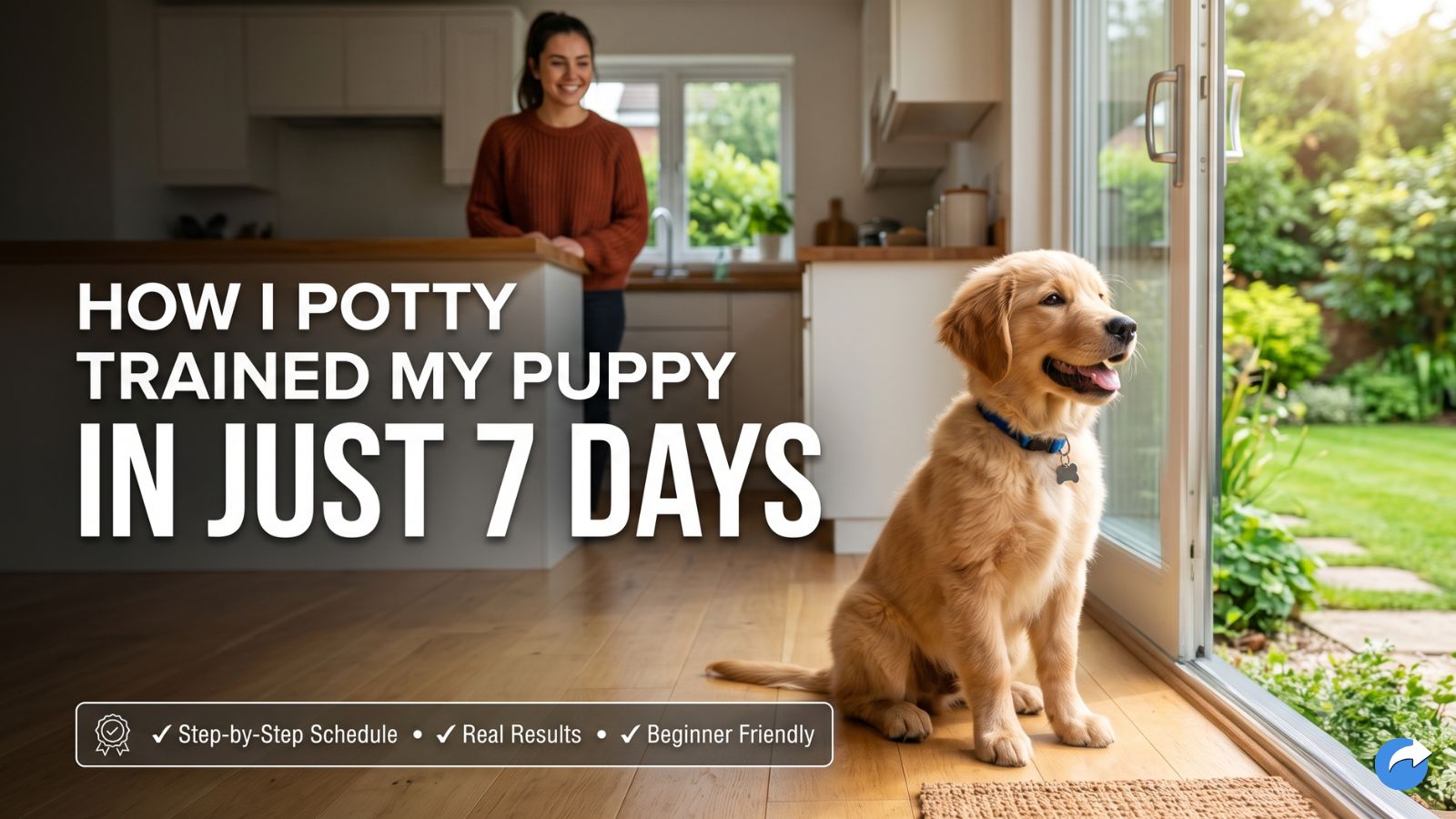
I brought Max home on a Saturday. He was 12 weeks old, a golden retriever with big paws and bigger eyes. By Sunday morning, my living room rug had three pee spots and a surprise pile I won’t describe.
I thought I made a huge mistake.
But I didn’t. Seven days later, Max was going to the back door when he needed to go. No more rugs ruined. No more 6 AM panic cleaning. Just a puppy who finally understood the rules.
Here’s exactly what I did, day by day. No complicated words. No confusing dog trainer talk. Just what worked for me and what will work for you too.

What You Need Before Day 1
Don’t skip this part. I tried without half this stuff and learned the hard way.

A crate that fits. Not too big. Your puppy should be able to stand up, turn around, and lie down. That’s it. If there is extra space, they will pee in one corner and sleep in the other. I made this mistake. Don’t.
A leash. Even if you have a backyard. I used a 6-foot leash every single potty trip for the whole first week. It keeps your puppy focused. Without it, Max would chase leaves for 20 minutes, come back inside, and pee on the floor.
Really good treats. Not the dry kibble stuff. I used tiny pieces of boiled chicken. Smelly. Soft. Pea-sized. These treats only come out for potty wins. Max only got chicken when he went outside. He figured that out fast.
Enzyme cleaner. Regular floor cleaner does not work. Your puppy can still smell where they went. They will go back to the same spot. Buy the enzyme kind from any pet store. I got two bottles. I used both.
A notebook or your phone. For two days, I wrote down everything. What time Max ate. What time he drank water. When he napped. When he peed. When he pooped. By day three, I could predict his bathroom breaks almost to the minute. This changed everything.
Day 1: Watch and Learn
Day 1 is not about training. It is about watching.
I took Max outside every 30 minutes. Not sometimes. Every single time. I carried him from the crate to the grass so he wouldn’t have an accident on the way.
I stood still. I didn’t talk. I didn’t play. I waited.
When he peed, I said “Go potty” in a calm voice while he was going. Not after. During. Then I gave him chicken right away. Within three seconds. Not ten seconds. Three.
Then we went back inside. No walk. No play. Peeing outside is the goal. Everything else is a reward later.
At night, I set an alarm for 3 AM. Yes, it was awful. I took Max out. He peed. I gave chicken. We went back to bed. I did this for four nights. By night five, he slept through.
What I learned on Day 1: Max peed 12 times and pooped 4 times. He always needed to go within 15 minutes of eating. He always needed to go right after waking up from a nap. These patterns became my schedule.
How long can your puppy hold it? Puppies can hold their bladder for roughly their age in months, plus one hour. So a 2-month-old puppy can hold it for about 3 hours max. A 3-month-old can hold it for about 4 hours. This is the limit, not the goal. Take them out more often than this.
Smaller breeds like Chihuahuas and Yorkies have tiny bladders. They need more breaks than bigger breeds at the same age. If you have a small breed puppy, add one or two extra trips per day.
Day 2: Stick to the Schedule
Day 2 is the same as Day 1, but now I had a schedule that I did not break.
- 6:30 AM: Wake up. Carry puppy outside. Potty.
- 7:00 AM: Breakfast. Water.
- 7:15 AM: Outside for potty.
- Every 30 to 60 minutes all day: Outside.
- After every nap: Outside.
- After every play session: Outside.
- 10:30 PM: Last potty. Into crate for bed.
- 3:00 AM: One nighttime potty trip.
Was it a lot of trips outside? Yes. I walked out that door 14 times on Day 2. Fourteen. But I had zero accidents. Zero.
My wife thought I was crazy. She said I was doing too much. But on Day 3, Max walked to the back door by himself for the first time. That moment would never have happened if I skipped trips on Day 2.
The key on Day 2 is simple. Do not break the schedule for any reason. Not because you are tired. Not because you are busy. Not because “he looks fine.” Stick to it.
Day 3: Reading the Signs
By Day 3, Max started telling me when he needed to go. I just had to pay attention.
Here is what I noticed. When Max needed to pee, he would suddenly stop playing. He would sniff the floor in circles. He would walk toward the back door and look at me.
These are the classic signs your puppy needs to go out:
- Sniffing the floor in circles
- Suddenly stopping play
- Walking toward the door
- Whining or pacing
- Sitting and staring at you
If I saw any of these signs, I grabbed the leash and went outside. Fast. No delay. If I waited even 30 seconds, I was cleaning the floor.
One time I caught Max mid-squat on the kitchen tile. I clapped once. I said “Ah-ah!” I picked him up and ran outside. He finished peeing on the grass. I gave him chicken. He wagged his tail. No yelling. No anger. No rubbing his nose in it.
The worst thing you can do is yell at your puppy after the accident already happened. They do not understand why you are mad. They just learn to be scared of you. A scared puppy is harder to train.
What I wrote in my notebook by Day 3: Max pees 10 minutes after drinking water. He poops 20 minutes after eating. He never poops during the night. He can now wait 60 to 75 minutes between trips instead of 30.
Day 4: Stretching It Out
Day 4 is when things started feeling easier.
Max had no accidents on Days 2 and 3. So on Day 4, I pushed the potty breaks a little further apart.

Instead of every hour, I went every 75 to 90 minutes. He handled it fine.
I also gave Max a little more freedom inside the house. But only the living room. Not the whole house. Not yet.
Here is a mistake I see people make on Day 4. They think the puppy is fully trained. They let the puppy roam everywhere. Then they find a pee puddle in the bedroom. A puppy who “gets it” in one room may not get it in another room. Go slow.
One room at a time. Earn the freedom. Start with the room you spend the most time in. Add more rooms gradually over the next few weeks.
I also started giving Max a short walk after he pottied outside. Not before. The walk was his reward for doing his business. He figured this out quickly. He started peeing faster because he knew the walk came next.
By the end of Day 4, Max went to the back door three times on his own. Each time, I took him out right away. Each time, he peed within 60 seconds. Each time, I gave him chicken. He was starting to trust the system.
Day 5: Adding Distractions
Day 5 is a test. Can your puppy follow the rules when life gets exciting?
My neighbor’s dog was barking in the yard next door. The mailman came to the front door. My kids were running around the house after school. These are all moments when Max would normally forget everything and pee on the spot.
So I planned ahead. Before any big excitement, I took Max out for a potty break. Doorbell rings? Potty first. Kids come home from school? Potty first. Someone new visits the house? Potty first.
I also took Max out during a light rain for the first time. He hated it. He stood there, shivering, looking at me like I was the worst person alive. I put on my raincoat, stood with him, and waited. Three minutes later, he peed. I gave him chicken like he just won the lottery.
Here is a tip for bad weather. If you live somewhere cold like Canada or the northern US or UK, your puppy might hate going out in the rain or snow.
Here is what helps:
- Go outside with them. Do not just open the door and hope they go.
- Cover the potty spot with a small tarp or umbrella so it stays dry.
- For small breeds, get a puppy coat. They get cold faster than big dogs.
- In winter, shovel a small “potty zone” in the snow. Puppies hate sinking belly-deep in snow.
The lesson of Day 5 is this. Real life is full of distractions. The doorbell rings. It rains. The neighbor’s dog barks. Your puppy needs to learn that the rules do not change when things get noisy or wet or exciting. Your job is to help them through it.
Day 6: Testing What He Knows
By Day 6, Max was a different puppy. He had not had an accident in four days. He was going to the back door on his own when he needed to go. He was responding to “Go potty” every single time.
But I did not get overconfident. I kept the schedule. I kept the leash. I kept the chicken treats. Overconfidence is where most people lose their progress.
I gave Max two rooms to explore instead of one. The living room and the hallway. I watched him like a hawk for the first hour. He explored. He sniffed around. He checked out the hallway rug. But he did not pee. Progress.
One thing I noticed on Day 6. Max started doing a little spin by the back door when he needed to go. It was his way of telling me. Every time I saw the spin, I opened the door and took him out. He peed within 90 seconds. Then I gave him chicken.
This is the real goal of potty training. Not that your puppy can hold it forever. But that they tell you when they need to go. Day 6 was the first day I felt Max truly understood this. He was not just following a schedule. He was communicating.
Day 7: The Big Test
Day 7. I wanted to make sure Max was not just good at my house. I wanted to make sure he understood the rule everywhere.
So I did three things.
First, I took him to my friend’s house. New yard. New smells. New everything. I put him on leash, walked him to a patch of grass, and said “Go potty.” He sniffed for about 30 seconds. Then he went. I almost cried. Chicken for Max. A lot of chicken.
Second, I took him for a walk in the park. Same result. He understood that “Go potty” means go to the bathroom here, right now. Not just at the back door at home. The behavior was generalizing. That is the real test.
Third, I tested the nighttime stretch. No 3 AM alarm. Last potty at 10:30 PM. First potty at 6:30 AM. Eight hours. Max made it through. No accidents. No whining. Just a puppy who was sleeping soundly and woke up ready to go outside.
Was Day 7 perfect? No. Max still needed supervision. He was not ready to be left alone for six hours with full run of the house. But we had gone from 12 accidents a day to zero. From constant cleaning to a calm, predictable routine. From “what have I done” to “I’ve got this.”
What Happens After Day 7
Seven days gets you to a good place. It does not get you to perfection. Here is what I did in weeks two, three, and four.
Stretch the time slowly. I added 15 minutes between breaks every few days. By week four, Max was going out every three hours during the day instead of every hour.
Add more rooms one at a time. I gave Max access to one new room every few days. The kitchen on Day 9. The bedroom on Day 12. The whole downstairs by Day 21. If he had an accident in a new room, I closed that door and waited two more days before trying again.
Cut back on treats. I did not stop treats completely. But instead of chicken every single time, I gave chicken every second or third time. Sometimes just praise. Sometimes just a quick scratch behind the ears. He still got the message that going outside was good.
Teach a clear signal. Some people teach their dog to ring a bell by the door. I did not do this with Max, but many puppy owners swear by it. If your puppy is having trouble telling you they need to go, hang a bell by the door. Ring it every time you go out for potty. Your puppy will learn to ring it themselves. It works especially well in apartments or houses where the back door is not always visible.
What to Do When Accidents Happen
They will happen. Even after Day 7. Here is exactly what to do.
If you catch your puppy mid-accident: Clap once. Say “Ah-ah!” Pick them up. Run outside. Let them finish there. Praise like crazy if they do.
If you find an accident later: Just clean it. That is it. Do not punish. Do not drag your puppy to the spot. They will not connect the punishment to something they did 10 minutes ago.
Always use enzyme cleaner. Regular soap and water does not destroy the smell markers in urine. Your puppy can still smell where they went and will go back to that same spot.
If accidents keep happening in the same spot: Your cleaner is not working. Get a better one. The enzyme kind. Then block access to that spot for a week.
The Schedule That Worked For Me
Here is the exact schedule I used with Max. He was 12 weeks old. Adjust the times to fit your life. But keep the order the same.
- 6:30 AM: Wake up. Carry puppy outside. Potty.
- 7:00 AM: Breakfast. Fresh water.
- 7:15 AM: Outside for potty.
- 8:00 AM: Playtime or training session.
- 8:30 AM: Outside for potty. Then crate nap.
- 10:30 AM: Wake up. Outside for potty.
- 11:00 AM: Play or training. Offer water.
- 12:00 PM: Lunch. Outside 15 minutes after.
- 2:00 PM: Wake from nap. Outside for potty.
- 3:00 PM: Supervised free time in one room.
- 4:30 PM: Outside for potty.
- 5:30 PM: Dinner. Outside 15 minutes after.
- 7:00 PM: Evening play session. Outside after.
- 9:00 PM: Take away water. No more drinking after this.
- 10:30 PM: Final potty of the day. Into crate for bed.
- 3:00 AM: Quick potty trip. Only for the first 4 to 5 nights.
By day four, I dropped the 3 AM potty break. By day seven, Max could go from 10:30 PM to 6:30 AM without a single problem.
The Biggest Mistakes I Made
Here are the mistakes I made so you do not have to repeat them.
I gave too much freedom too early. On Day 3, I let Max wander into the bedroom. He peed on the carpet. I learned the hard way. Keep your puppy in one room at first. Add more rooms slowly over time.
I rewarded too late. The first two days, I fumbled with the treat bag after Max peed. Ten seconds passed before I gave him the chicken. By then, he had already forgotten what the treat was for. Reward within three seconds. Have the treat ready in your pocket before you go out the door.
I free-fed him. I left food out all day during the first week. Bad idea. You cannot predict when your puppy needs to potty if they eat whenever they want. Fixed meal times equal a fixed potty schedule. Feed breakfast, lunch, and dinner at the same times every day.
I skipped potty breaks when I was busy. I had a work call. I thought Max could wait 20 more minutes. He could not. Stick to the schedule even when it is inconvenient. One skipped break can undo two days of progress.
I got frustrated and Max felt it. Puppies read your energy. If you are angry and tense, they get nervous. Nervous puppies have more accidents, not fewer. Stay calm. Clean it up. Move on.
What If It’s Not Working?
Some puppies take longer than others. That is normal. But sometimes there is a health problem. Call your vet right away if you see any of these:
- Blood in the urine
- Your puppy straining or crying while trying to pee
- Suddenly needing to go much more often than before
- Drinking water nonstop all day long
- A puppy who was doing great and then suddenly regressed with no reason at all
Urinary tract infections are common in puppies. They are easy to treat with medicine from your vet. But you need a vet to check. Do not wait and hope it gets better on its own.
Also, if you have a rescue dog or an older puppy, they may have bad habits from their previous situation. The same schedule still works. It just might take two weeks instead of one. Do not give up.
Commonly Asked Questions
Can I really potty train my puppy in 7 days?
Yes and no. In 7 days, a healthy puppy 12 weeks or older can learn the routine. They will know where to go, when to go, and how to signal you. But full bladder control takes longer. Most puppies are not 100% accident-free until they are 4 to 6 months old. Seven days gets you most of the way there.
Should I use puppy pads or go straight to outdoor training?
If you have a yard or easy outdoor access, skip the pads. Pads teach your puppy that going inside is sometimes okay, which confuses them. Pads only make sense if you live in a high-rise apartment, have mobility issues, or your puppy is too young to go outside before vaccinations.
What cue word should I use?
It does not matter. “Go potty,” “do your business,” “hurry up,” and “be quick” all work. Just pick one word and use it every single time. Say it while they are going, not before and not after. Be consistent.
What if my puppy pees right after coming back inside?
This is a common problem. It usually means your puppy got distracted outside and never fully emptied their bladder. Fix: stand completely still and silent at the potty spot. Ignore them. Wait a full 5 to 10 minutes. No playing. No walking. If they still do not go, put them in the crate for 15 minutes and try again.
How do I handle nighttime?
Take away water by 9 PM. Take your puppy out for one last potty right before you go to bed, around 10:30 PM. For the first 4 to 5 nights, set an alarm for one middle-of-the-night trip. After that, most puppies 12 weeks and older can sleep through the night.
You Can Do This
I brought Max home on a Saturday full of doubt. By the next Saturday, I had a puppy who understood where to go and how to tell me. Not a perfect puppy. Not a robot. But a puppy I could live with without losing my mind.
The formula is not magic. It is boring. Same spot. Same leash. Same cue word. Same treat. Every single time. Over and over.
Your puppy wants to get it right. Your job is to make it clear what “right” looks like.
Week one is hard. Week two is easier. By week four, you will almost forget how stressful Day 1 felt. Almost.

Now go. Your puppy probably needs to pee.