

A reliable recall can save your dog’s life. This guide walks you through every step to teach a rock-solid come command.
Simply put, training a dog to come when called uses positive reinforcement, consistent practice, and gradual distraction proofing to build a reliable recall that works in any environment.
Key Takeaways
- Start recall training in a quiet indoor space with high-value treats before adding any distractions.
- Use a consistent cue word and reward every single successful recall during the learning phase.
- Never call your dog for something unpleasant like a bath or nail trim.
- Practice on a long line outdoors before attempting off-leash recall in unfenced areas.
- According to the American Kennel Club, dogs trained with positive reinforcement show faster learning and fewer stress signals than those trained with corrections.
What You Need Before You Start
Gather these items before your first training session. Having everything ready keeps sessions smooth and focused.
- High-value treats cut into pea-sized pieces such as boiled chicken, cheese, or commercial training treats
- A 15 to 30 foot long line made of lightweight nylon or biothane
- A well-fitted harness that does not restrict shoulder movement
- A clicker or consistent marker word like “yes” to mark the exact moment your dog responds
- A treat pouch worn at your waist for quick access
- Two identical toys for the “two-toy game” method if your dog prefers play over food
Tip: Test treat value before training. Offer two options and see which your dog chooses. Use that one for recall only.
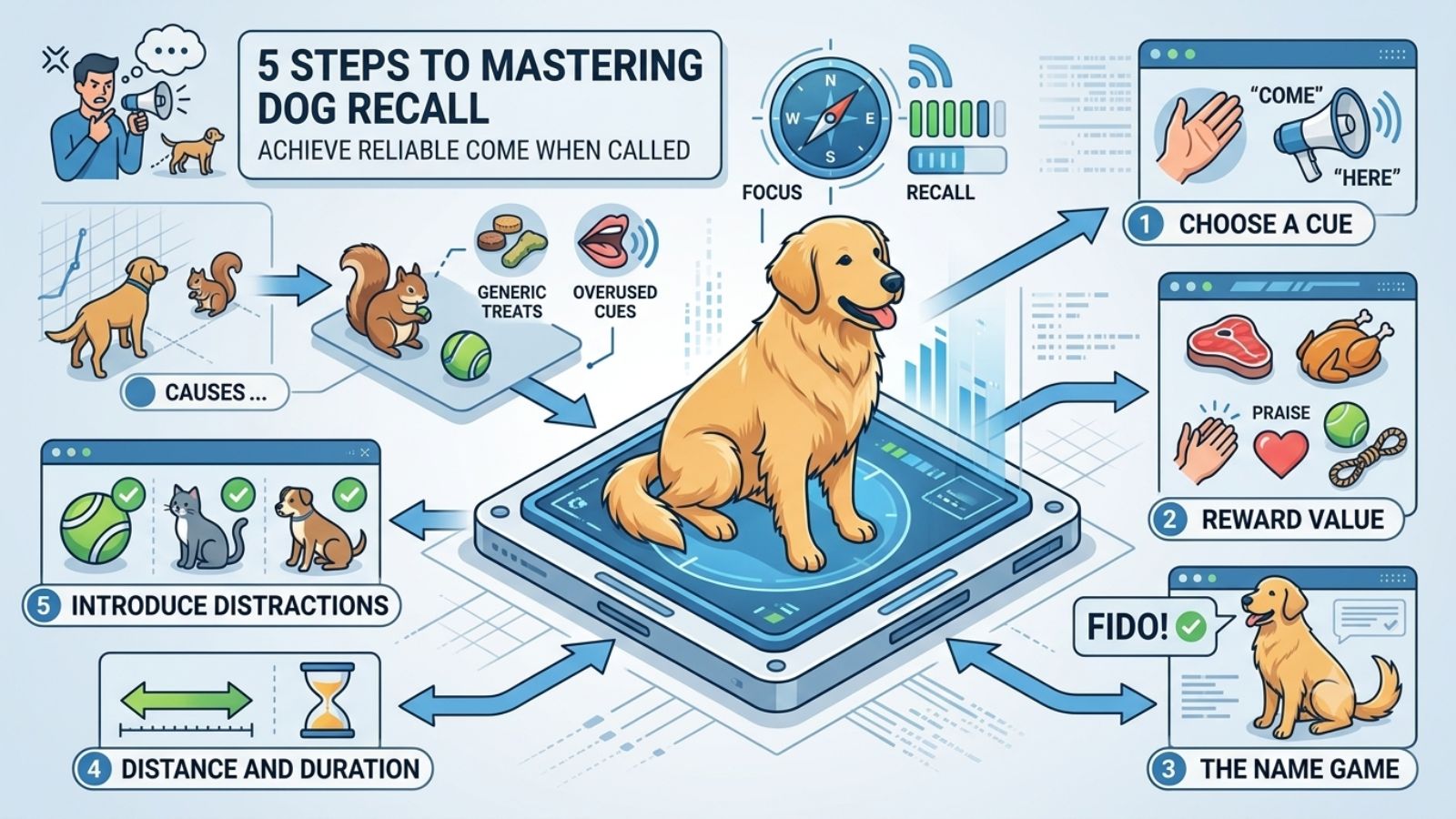
How to Train a Dog to Come When Called: Step-by-Step Process
Follow these steps in order. Do not rush. Each step builds the foundation for the next.
Step 1: Charge the Marker
- Click the clicker or say your marker word.
- Immediately give a treat.
- Repeat 10 to 15 times until your dog looks at you expectantly when hearing the marker.
Step 2: Teach the Cue Up Close
- Stand two feet from your dog in a quiet room.
- Say your chosen cue “come” or “here” in a happy tone.
- As your dog moves toward you, mark and reward at your feet.
- Repeat 10 times per session, two to three sessions daily.
Step 3: Add Distance Indoors
- Increase distance to 10 feet, then 20 feet, then across rooms.
- Call from different rooms so your dog learns to find you.
- Always reward at your feet, not by tossing the treat.
Step 4: Move to a Fenced Yard on Long Line
- Attach the long line to the harness.
- Let your dog explore while you hold the line.
- Call when your dog is mildly distracted, not fully focused on something else.
- Reel in gently if needed, then mark and reward generously.
Step 5: Proof with Controlled Distractions
- Have a helper walk past at a distance while you call.
- Place a low-value toy on the ground, call your dog away from it.
- Practice near other calm dogs at a distance.
- Increase distraction level only after 80 percent success at current level.
Step 6: Practice Real-World Scenarios
- Call your dog from play with another friendly dog.
- Call away from interesting smells on a walk.
- Practice at different parks, trails, and neighborhoods.
- Always use the long line until recall is 95 percent reliable.
Important: If your dog ignores the cue, do not repeat it. Go get your dog or reel in the long line. Repeating the cue teaches your dog that “come come come” is the actual command.
What to Expect: Timeline and Progress
Every dog learns at a different pace. Breed, age, history, and consistency all affect speed.
| Training Phase | Typical Duration | Success Criteria |
|---|---|---|
| Indoor foundation | 1 to 2 weeks | 90 percent response at 20 feet |
| Yard on long line | 2 to 4 weeks | 80 percent response with mild distractions |
| Distraction proofing | 1 to 3 months | 80 percent response with high distractions |
| Off-leash reliability | 3 to 6 months | 95 percent response in varied environments |
According to a study published in the Journal of Veterinary Behavior, dogs trained with reward-based methods achieved reliable recall in fewer sessions than dogs trained with mixed methods including corrections.
Common Mistakes to Avoid
These errors undermine progress and can create a dog that actively avoids coming when called.
- Calling your dog for unpleasant things like baths, crate time, or leaving the dog park
- Repeating the cue multiple times which teaches your dog to wait for the third or fourth call
- Chasing your dog when they do not come which turns recall into a game of tag
- Using a harsh tone or punishment when your dog finally arrives
- Practicing only when you need it instead of daily structured sessions
- Skipping the long line phase and going straight to off-leash in open areas
- Rewarding inconsistently or with low-value treats during the learning phase
Warning: Never punish your dog for coming to you, even if they ignored you five times first. The last behavior before the reward is what gets reinforced. Punishing arrival teaches your dog that coming to you leads to bad things.
Pro Tips for Faster Progress
These strategies come from professional trainers and behavior consultants.
- Play the “ping-pong” game with two people calling the dog back and forth for high-energy practice
- Use a whistle as a secondary recall cue that carries farther than your voice
- Reward with a “jackpot” of 10 to 15 treats delivered one at a time for breakthrough moments
- Practice “collar grab” during recall so your dog accepts handling when they arrive
- Train an emergency recall with a unique cue and the highest-value reward for dangerous situations
- End every session on a win, even if you need to make the last rep easier
- Video your sessions to spot timing errors you miss in the moment
What Is Recall Training and Why Does It Matter
Recall training teaches your dog to return to you immediately when cued, regardless of distractions. It is the single most important safety skill any dog can learn. A reliable recall prevents dogs from running into traffic, approaching dangerous wildlife, or getting lost.
The American Veterinary Medical Association identifies lack of recall as a leading factor in dog bite incidents and lost pet reports. Dogs with solid recall enjoy more freedom, more off-leash time, and stronger bonds with their owners.
How Does Positive Reinforcement Build Reliable Recall
Positive reinforcement strengthens the behavior you want by adding something the dog values immediately after the behavior occurs. When your dog comes and gets a high-value treat, the neural pathway for “come equals good things” grows stronger.
Research from the University of Pennsylvania School of Veterinary Medicine shows that dogs trained with positive reinforcement display fewer stress behaviors, higher engagement, and better long-term retention than dogs trained with aversive methods.
Common Myths vs Facts
- Myth: You need an e-collar for reliable recall. Fact: Thousands of working dogs including search-and-rescue, service, and detection dogs achieve off-leash reliability without shock collars.
- Myth: Some breeds cannot learn recall. Fact: Every breed can learn recall. Hounds and terriers may need more repetitions and higher-value rewards, but the process is the same.
- Myth: Once trained, recall is permanent. Fact: Recall requires lifelong maintenance. Practice weekly even after your dog is reliable.
Frequently Asked Questions
How long does it take to train a dog to come when called?
Most dogs learn the basic cue in one to two weeks of daily practice. Reliable off-leash recall in distracting environments typically takes three to six months of consistent training. According to the Certification Council for Professional Dog Trainers, consistency matters more than session length.
What if my dog only comes when I have treats?
Fade treats gradually by switching to a variable reward schedule. Reward every other recall, then every third, then randomly. Always keep the marker consistent. The American Kennel Club recommends maintaining occasional food rewards for life to keep the behavior strong.
Can I train recall with an older rescue dog?
Yes. Adult and senior dogs learn recall using the same steps. Start with higher-value treats and shorter sessions. A study in Applied Animal Behaviour Science found that older dogs can learn new behaviors at rates comparable to younger dogs when motivation is high.
Should I use a clicker or a marker word?
Both work. Clickers provide precise timing and a unique sound. Marker words like “yes” are always with you. Choose one and stay consistent. The Karen Pryor Academy teaches that the marker must occur at the exact moment the dog turns toward you.
What do I do if my dog runs away from me?
Do not chase. Run the opposite direction while making excited noises. Most dogs will instinctively chase you. If your dog is on a long line, reel in calmly. Never scold when they reach you. The ASPCA advises that chasing triggers prey drive and makes the dog run faster.
Final Thoughts
A reliable recall gives your dog freedom and keeps them safe. Build the foundation slowly, reward generously, and never call your dog for anything unpleasant. The long line is your safety net – use it until you are certain. Consistent practice beats perfect technique every time.