
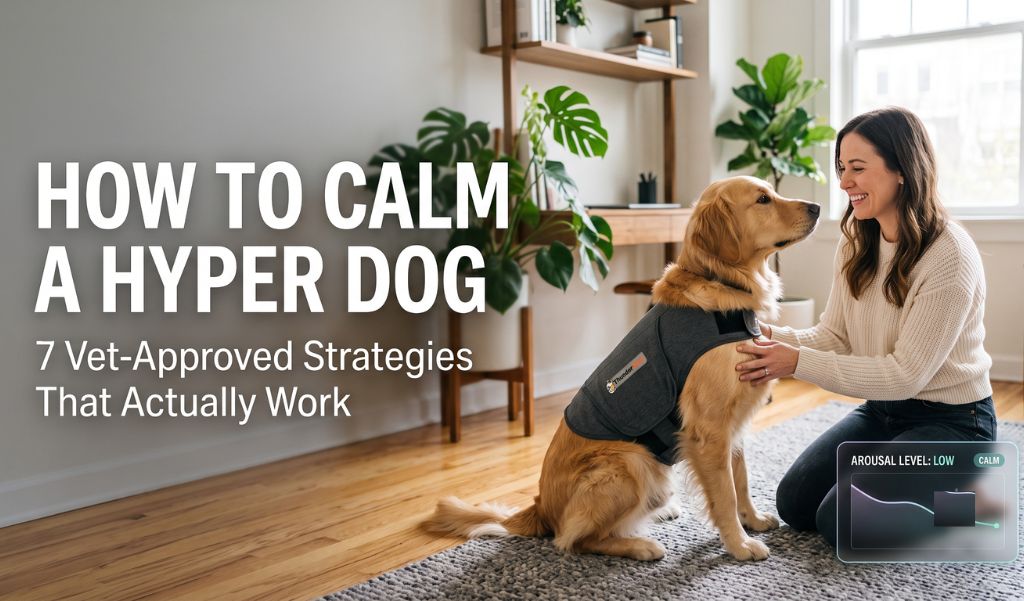
Your dog ricochets off the walls at 9 PM, launches at the doorbell, and can’t settle even after an hour of fetch. You’re not alone – hyperactivity is one of the most reported behavior complaints dog owners bring to trainers. The good news: in most dogs it isn’t a personality flaw. It’s a signal that a need isn’t being met.
Below are the 7 strategies that actually work, starting with what to do in the moment and ending with when to call the vet.
The 30-Second Version
- Now: Take the dog away from whatever is exciting it. No yelling, no chasing.
- Next 5 minutes: Offer a settle activity – chew, lick mat, or a quiet room.
- Today: Add a sniffy walk, a puzzle, and a predictable routine.
- This week: Practice a “settle on a mat” cue in calm moments.
- If it keeps happening: Book a vet check to rule out medical causes.
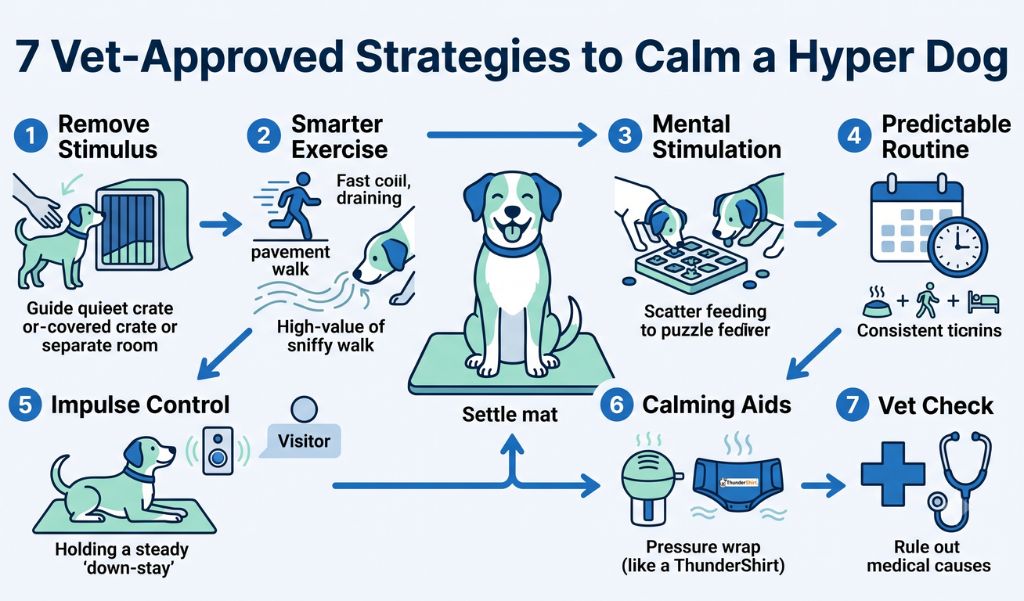
1. Instant Calm: Remove the Stimulus First
Before any training can work, you have to lower the arousal. A hyper dog mid-zoom is past the point of listening – their brain is in overdrive, not learning mode.
What to do right now
- Leave the room. Move yourself out of the picture. Most hyper spells are bids for engagement; no audience, no game.
- Use the crate as a calm space – never a punishment. A covered crate in a quiet room blocks visual triggers and gives the nervous system a chance to drop.
- Pick up a small dog and carry it to another room. For big dogs, attach a leash and walk them calmly away – don’t grab the collar and drag.
- Lower your own energy. Speak softly, move slowly. Dogs read your arousal state and mirror it.
The mistake that makes it worse
Yelling, chasing, or grabbing the dog while it’s excited. It reads as more arousal, and it teaches nothing.
Science-backed why: a dog in a high-arousal state can’t absorb training. Calm has to come first; learning comes second. That’s why every strategy below starts with lowering the energy in the room.
2. Exercise Smarter, Not Just Longer
The biggest misconception: “my dog just needs more exercise.” For many hyper dogs, the problem isn’t the amount – it’s the type. Fetch and leash walks build aerobic fitness but leave a clever dog mentally starving.
What actually tires a dog
- Sniffy walks over fast walks. Let the nose lead. 20 minutes of serious sniffing can tire a dog more than an hour of pavement pacing.
- Off-leash running in a safe, fenced area – dogs need to choose their own pace.
- Breed-matched activity. A Border Collie needs a job (herding, agility, tricks); a Labrador needs retrieval; a scent hound needs nose work. Match the outlet to the instinct.
- Short bursts throughout the day beat one long outing. Spaced activity keeps arousal flat.
Aim for: 30-60 minutes of physical activity daily plus a session of mental work – adjusted for breed, age, and health.
Why length isn’t the fix: a dog kept “aerobically fit but mentally starved” stays amped. Exercise drains the body; mental work drains the brain. Hyper dogs usually need both.
3. Mental Stimulation: The Missing Piece
Most hyper dogs are brilliant and bored. Brain work is often more tiring than physical exercise – it activates the problem-solving parts of the brain, not just the legs.
Easy ways to add brain work today
- Puzzle feeders and treat-dispensing toys – turn dinner into a job.
- Scent games. Hide treats or kibble around the house and let the dog find them. Their nose is their strongest sense.
- Scatter feeding. Scatter food on a lawn or mat instead of a bowl. It slows eating, engages foraging instincts, and produces a visibly calmer dog.
- Short training sessions (5 minutes, twice a day) teaching a new trick or cue.
Tip: if your dog is already overwhelmed, mental games won’t work in that moment – create distance and lower pressure first, then engage the brain.
Don’t skip this section: a “tired” hyper dog is often just a dog whose body is exhausted and whose brain is still switched on. Fix the brain, and the body follows.
4. A Predictable Routine Calms From the Inside
Hyperactivity often spikes when the day is unpredictable. A dog that never knows when exercise or dinner is coming stays “on” – pacing, whining, and jumping as a way of soliciting engagement.
Build a rhythm the dog can rely on
- Morning: structured exercise – walk, run, or play session.
- Midday: mental work – training, puzzle feeder, or scent game.
- Evening: low-stimulation wind-down. No roughhousing before bed.
- Same feeding and walk times every day where possible.
The payoff: predictability is calming in itself. Once your dog knows what comes next, the frantic bid for attention usually drops within a week or two.
What “routine” really does: it removes uncertainty, which removes a major source of stress-arousal. You can’t always control the environment, but you can control the structure around it.
5. Train Impulse Control – Not Just Obedience
A dog who sits on command but can’t hold the sit when the doorbell rings doesn’t have impulse control – it has a trick. Real calm comes from training the pause, in increasingly distracting settings.
Four exercises that build self-control
- “Settle on a mat.” Teach the dog to lie on a mat or bed on cue and stay while the world goes on around it. Start boring, then add distractions gradually.
- Stay with distractions. Increase duration and distance while real-world chaos happens – kids, visitors, the TV.
- “Leave it.” Practice with high-value items until the dog can ignore them on cue.
- Wait at doors and thresholds. The dog waits before crossing any doorway – one of the strongest impulse-control habits you can build.
Expect: weeks of short daily practice. The cue only works if it was solid before you needed it – train it when the dog is already calm.
The mechanic: these exercises rewire the default response from “charge ahead” to “check in first.” Over time, that becomes the dog’s baseline – calmer across the whole day, not just after a training session.
6. Calming Aids: Useful Tools, With Honest Limits
Calming products can help – as a support, not a substitute for exercise, structure, and training. If the dog’s daily needs aren’t met, no product will fix it.
Options that help some dogs
- Pheromone diffusers and collars (DAP/adaptil-style) – mimic calming signals; work best as background support.
- Pressure wraps (ThunderShirt-style) – gentle constant pressure; most useful for specific triggers like storms or fireworks.
- Calming supplements – ingredients like L-theanine, L-tryptophan, and magnesium show some evidence for anxiety-related behavior.
- Calming treats – effects are slow (weeks, not minutes) and the evidence is limited; check ingredients and ask your vet first.
What to expect honestly: results vary widely between dogs. These tools reduce some stress in some dogs; they rarely transform a hyper dog on their own. Treat them as one tool in the box, and watch for allergies or reactions.
Our take: spend your first two weeks on exercise, brain work, routine, and impulse control. Add calming aids only if specific triggers (storms, visitors, travel) keep spiking the arousal – and always run them past your vet.
7. When to See the Vet
Sometimes hyperactive behavior isn’t behavioral at all. If the strategies above haven’t helped after a few weeks of consistent practice – or if the behavior came on suddenly – a vet check is the right call.
Book a vet visit if you see
- Sudden onset of frantic, restless, or destructive behavior with no clear trigger.
- Signs of illness alongside it – pain, pacing, excessive panting, loss of appetite.
- Persistent escalation despite meeting exercise, enrichment, and routine needs.
- Suspected medical causes – conditions like hyperthyroidism can present as hyperactivity (rare, but possible).
What the vet may recommend: a full exam to rule out pain or thyroid issues, and in severe, persistent anxiety, medication such as fluoxetine or similar – always prescribed and monitored by a veterinarian.
The bottom line on medical help: ruling out health issues first protects your dog and saves you from months of training the wrong problem. When behavior doesn’t respond to the right training, look for a physical cause.
Frequently Asked Questions
How do I calm a hyper dog quickly?
Remove the trigger first – leave the room, use a covered crate, or move to a quiet space – then offer a chew or lick mat and wait for calm before giving attention. Calm comes before training.
Why is my dog so hyper all the time?
Usually unmet needs: too little exercise, too little mental stimulation, an unpredictable routine, or high arousal triggers in the environment. Occasionally it’s a medical issue – a vet can rule that out.
Does more exercise calm a hyper dog?
Yes, but smarter beats longer. Sniffy walks, off-leash running, and breed-matched activity drain more energy than pavement walking. Combine physical work with brain work – mental stimulation often tires a dog more than an hour of fetch.
Are calming treats safe for dogs?
Most are safe when used as directed, but effects are slow and evidence is limited. Check the ingredient list, watch for reactions, and always ask your vet before introducing supplements or treats.
Should I crate my hyper dog to calm it?
Yes – if the crate is a trained, positive calm space, not a punishment. A covered crate in a quiet room blocks triggers and helps the nervous system settle. Never force a scared dog in.
How long does it take to calm a hyper dog?
Most owners see meaningful change within 2-4 weeks of consistent exercise, brain work, routine, and impulse-control practice. Long-standing habits or medical causes take longer and may need professional help.
Affiliate disclosure: This article may contain affiliate links. We only recommend products we believe in. As an Amazon Associate, dogtrainings earns from qualifying purchases.