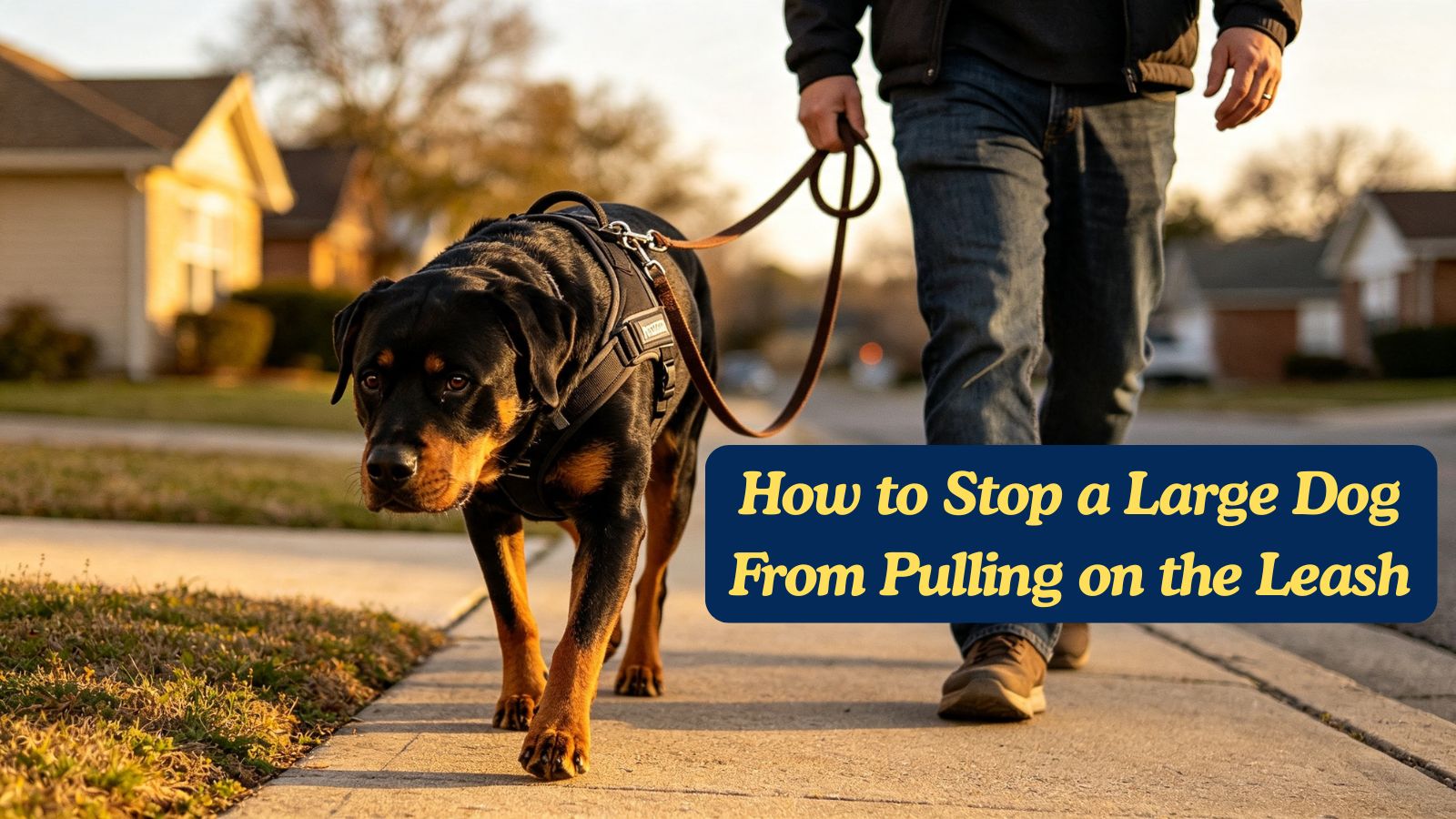
How to Stop a Large Dog From Pulling on the Leash
If your arm feels wrecked by the end of every walk, start with three changes: reward your dog for walking on a loose leash, stop moving whenever the leash goes tight, and use equipment that makes a strong pull easier to manage, such as a properly fitted front-clip harness. These steps won’t fix every dog at the same speed, but they give you a clear system to work with from day one.
I trained my own dog, Gus, a 78-pound Rottweiler mix, after roughly two years of persistent leash pulling. We worked in short daily sessions for about five weeks, and I paid attention to how often he pulled, checked in with me, and managed familiar walking routes without sustained leash tension. That was our experience, not a guaranteed timeline for every dog. Dogs differ in age, training history, environment, motivation, and reactivity. Here’s what actually worked, what didn’t, and why large-dog leash training is more about mechanics and consistency than force.
Why Do Large Dogs Pull So Much Harder Than Small Dogs?
It’s leverage, not attitude. A 70-pound dog leaning into a flat collar can generate enough force to pull a grown adult off balance, especially on wet pavement or gravel. A 15-pound dog just can’t produce the same torque, even if it’s pulling with everything it’s got.
This is also why the “just be a stronger pack leader” advice you’ll see on some old-school forums doesn’t hold up. Strength isn’t really the variable. Mechanics and reinforcement history are. A dog pulls because pulling has worked before. It got the dog to the tree, the other dog, the smell, faster than walking politely did.
The American Veterinary Society of Animal Behavior’s position statement on humane dog training recommends reward-based training methods and advises against aversive tools and techniques. That’s the backbone of everything below.
What Is the Best Way to Stop Leash Pulling?
The most reliable approach combines three things at once:
- Equipment that can make pulling easier to manage. A properly fitted front-clip harness is one option, especially for dogs that are difficult to control on a collar alone.
- The stop-and-stand method. The second the leash goes taut, you stop walking and wait for slack before moving again.
- Reinforcing position, not just behavior. Reward the dog for being near your leg, not just for “not pulling.”
Some dogs show noticeable improvement quickly, while dogs with a long pulling history often need much more repetition. Gus went from dragging me the first ten feet out the door to walking a full block on a loose leash within the first couple of weeks, though he backslid hard the first time we passed a delivery truck.
If you haven’t picked equipment yet, our guide to the best no-pull leashes breaks down front-clip harnesses versus head halters versus retractable leashes. Skip the retractables, for what it’s worth; they teach tension, not slack.
Should You Use a Front-Clip Harness or a Head Halter?
Both are tools. They work differently.
Front-clip harnesses such as the PetSafe Easy Walk and 2 Hounds Design Freedom Harness attach the leash at the dog’s chest rather than behind the shoulders. That changes how the leash force is directed when the dog moves forward and can make strong pulling easier for the handler to manage. The harness is a management tool, though. The dog still needs to learn loose-leash walking; it won’t do the training for you.
A head halter, like the Gentle Leader, controls the head instead of the body. A head halter can give the handler additional control because it changes where leash pressure is directed, but dogs generally need gradual conditioning before wearing one comfortably. Follow the manufacturer’s fitting and introduction instructions, and get professional help if your dog reacts strongly to the equipment.
I tried both with Gus. The head halter gave me more stopping power around other dogs, but he fought it for the first week. The front-clip harness was the one that stuck for daily walks.
AVSAB recommends reward-based training and advises against aversive tools such as prong collars, choke chains, electronic collars, and hard leash corrections. For a strong puller, I’d start with management equipment and reward-based training rather than relying on pain or discomfort to suppress the behavior.
How Does the Stop-and-Stand Method Actually Work?
You plant your feet the instant the leash gets tight. No jerking, no yelling, no forward motion at all. You just become a tree.
The dog will usually turn around, confused, wondering why the walk stopped. That’s the moment you wait for slack in the leash, even an inch, and then say something like “yes” or click a clicker, and start walking again.
Repeat. Every single time the leash tightens, you stop. This is tedious. Your first sessions might cover fifty feet in fifteen minutes. That’s fine. You’re not walking the dog for exercise yet; you’re teaching a rule.
Using constant leash pressure instead can turn the walk into a physical tug-of-war. Instead of repeatedly pulling backward on the leash, stop moving and reward the moment your dog creates slack on their own.
The mistake most people make is stopping the method too early because the dog “isn’t getting it” after two days. Behavior that’s been rewarded for years doesn’t reverse in 48 hours. Give it real repetitions before judging whether it’s working.
How Do You Teach Loose-Leash Walking From Scratch?
Start indoors or in the yard, somewhere boring, before ever touching a real walk. Clip the leash on, stand still, and reward your dog for choosing to stay near your leg. No walking yet.
Once your dog checks in reliably at home, add a few steps of movement. Reward loose leash, stop on tight leash, repeat. Only after that becomes automatic in a low-distraction space should you move to a quiet street.
This order matters more than most people expect. Practicing exclusively on real walks, in a busy environment with squirrels, other dogs, and delivery trucks, is like trying to learn multiplication tables during a fire drill. Build the skill somewhere calm first, then add distractions gradually.
For dogs who are still working on basic attention and impulse control before you even tackle the leash, our basic dog training tips post covers that foundation.
What if My Dog Only Pulls Toward Other Dogs or Strangers?
That’s a different problem wearing the same clothes. Pulling toward a trigger, another dog, a jogger, a bike, is often about arousal or fear, not general leash manners. Standard loose-leash exercises help, but they’re not enough on their own.
A practical way to judge distance: if your dog can notice another dog and still take a treat or respond to their name, you’re probably still at a workable distance. If your dog is already barking, lunging, freezing, or refusing food entirely, you’re too close. Move farther away and try again from there.
This is where a lot of owners get stuck, because they assume more obedience training will fix it, when the dog actually needs distance and desensitization work first. If your dog is lunging, barking, or freezing up around specific triggers, treat it as its own project. Our reactive dog training methods guide covers threshold distance and counter-conditioning, which matter more here than leash mechanics do.
Does Leash Pulling Get Worse With Age, or Easier?
Generally easier, if you’re training. Worse, if you’re not.
Puppies pull because everything is new and they have zero leash conditioning yet. Adolescence can be a particularly challenging stage because the dog is physically stronger while impulse control and training are still developing. This is often the window where owners get frustrated and reach for punitive tools instead of sticking with the plan.
If you’re starting with a puppy, you have an advantage: no bad habit to unlearn yet. Our post on training a large breed puppy covers leash introduction before pulling ever becomes a pattern, which is a much easier fight than retraining a 90-pound adult.
Adult dogs with years of pulling history absolutely can improve. It just takes longer and more consistency, because you’re competing with a longer reinforcement history.
How Long Does It Take to Fix Leash Pulling?
There’s no reliable universal timeline. Your dog may improve noticeably after a few consistent sessions, while a strong adult puller with years of reinforcement history can need much longer. The useful thing to track is progress, not a deadline: fewer hard pulls, more check-ins, longer stretches of loose leash, and better recovery around distractions.
Gus made meaningful progress after about five weeks of consistent daily practice, despite years of pulling history behind him. That describes Gus, not a guaranteed schedule for your dog.
My 5-Week Leash Training Test With Gus
I wanted to know if this method was actually working or if I was just telling myself it was, so I paid close attention instead of guessing. Equipment used: a 2 Hounds Design Freedom Harness and a standard 6-foot leash, on the same three routes near my house each week.
I didn’t log exact pull counts or stopwatch times, so I’m not going to present a table of numbers I can’t back up. What I can say from direct observation, week to week:
- Week 1: Constant stopping, almost every few steps. The walk was mostly standing still.
- Week 2: He started glancing back at me before hitting the end of the leash, instead of just pulling through it.
- Week 3: Loose leash on our own street was becoming the norm. Anything near the dog park entrance still fell apart completely.
- Week 4 to 5: Familiar routes were consistently loose-leash. Squirrels and unfamiliar dogs were still hard triggers, no real change there yet.
Those results describe Gus, not a guaranteed training schedule for every dog. They did show me where his specific problem areas were, familiar and low-stimulus first, novel and high-arousal last, which mattered more for planning our training than a generic timeline would have.
If you’re tracking your own dog’s progress and want harder numbers than this, a simple log of pulls-per-walk or minutes-of-loose-leash before the first hard pull will tell you more than a calendar will.
When Should You Get Professional Help?
If your dog is strong enough to pull you off your feet, regularly lunges at people or dogs, has bitten someone, or can’t settle enough to take food around triggers, get professional help rather than trying to solve it with harsher equipment on your own.
For serious behavior problems, look for a qualified reward-based trainer or a veterinary behaviorist. AVSAB’s guidance on choosing a trainer is a reasonable place to start when vetting who to work with.
What Are the Most Common Mistakes People Make?
Inconsistency. Letting the dog pull on “easy” walks and correcting on others confuses the whole system. The dog can’t tell which walk is which.
Giving up on stop-and-stand too soon. Five minutes of frustration isn’t a fair trial.
Using the wrong equipment for the dog’s size and strength. A tiny harness on a large, strong dog fails mechanically before training even gets a chance to work.
Training only on real walks. If your dog only practices leash skills during a chaotic neighborhood walk, you’re making the lesson harder than it needs to be. Practice indoors, in the yard, in the driveway, and on quiet streets before adding busier environments.
Skipping the basics. Loose-leash walking sits on top of a foundation of attention and impulse control. If your dog doesn’t reliably check in with you or respond to their name around low-level distractions, start there.
The Bottom Line
Large dog, big leverage, same training principles as any other dog, just less room for error. A front-clip harness or a properly conditioned head halter, stopping the second the leash tightens, and rewarding loose leash consistently will get most dogs moving in the right direction. Treat reactivity as its own separate project if that’s part of what you’re dealing with.
Gus made meaningful progress after about five weeks of consistent practice, despite having years of pulling history. Your dog may improve faster or take considerably longer. The signs worth watching for are gradual: fewer hard pulls, more check-ins, longer stretches of slack leash, and better control around distractions.